
Mem0
The Memory Layer for Personalized AI.
Learn more »




# Mem0: The Memory Layer for Personalized AI
[Mem0](https://mem0.ai) enhances AI agents and Large Language Models (LLMs) with an intelligent memory layer. By retaining and utilizing contextual information, Mem0 enables more personalized and effective AI interactions across various applications. Whether you're building customer support chatbots, AI assistants, or autonomous systems, Mem0 helps your AI remember user preferences, adapt to individual needs, and continuously improve over time.
Use cases enabled by Mem0 include:
- **AI Assistants and agents**: Seamless conversations with a touch of déjà vu – just like this one
- **Personalized Learning**: Tailored content recommendations and progress tracking
- **Customer Support**: Context-aware assistance with user preference memory
- **Healthcare**: Patient history and treatment plan management
- **Virtual Companions**: Deeper user relationships through conversation memory
- **Productivity**: Streamlined workflows based on user habits and task history
- **Gaming**: Adaptive environments reflecting player choices and progress
## Get Started
The simplest way to set up Mem0 is to create a managed deployment with Mem0 Platform. The platform is a hosted solution and offers a hassle-free experience with automatic updates, advanced analytics, and dedicated support. [Sign up](https://app.mem0.ai/) for Mem0 Platform to get started.
If you prefer to install and manage Mem0 yourself, you can use the open-source Mem0 package. Read the [Installation instructions](#install) below to get started with Mem0 on your machine.
## Installation Instructions
The Mem0 package can be installed directly from pip command in the terminal.
```bash
pip install mem0ai
```
Alternatively, you can use Mem0 in one click using the hosted platform [here](https://app.mem0.ai/).
### Basic Usage
Mem0 supports a variety of LLMs, with details available in our [Supported LLMs documentation](https://docs.mem0.ai/llms). By default, Mem0 comes equipped with `gpt-4o`. To use it, simply set the keys in the environment variables.
```python
import os
os.environ["OPENAI_API_KEY"] = "sk-xxx"
```
Now, you can simply initialize the memory.
```python
from mem0 import Memory
m = Memory()
```
You can perform the following task on the memory.
1. Add: adds memory
2. Update: update memory of a given memory_id
3. Search: fetch memories based on a query
4. Get: return memories for a certain user/agent/session
5. History: describes how a memory has changed over time for a specific memory ID
```python
# 1. Add: Store a memory from any unstructured text
result = m.add("I am working on improving my tennis skills. Suggest some online courses.", user_id="alice", metadata={"category": "hobbies"})
# Created memory --> 'Improving her tennis skills.' and 'Looking for online suggestions.'
```
```python
# 2. Update: update the memory
result = m.update(memory_id=, data="Likes to play tennis on weekends")
# Updated memory --> 'Likes to play tennis on weekends.' and 'Looking for online suggestions.'
```
```python
# 3. Search: search related memories
related_memories = m.search(query="What are Alice's hobbies?", user_id="alice")
# Retrieved memory --> 'Likes to play tennis on weekends'
```
```python
# 4. Get all memories
all_memories = m.get_all()
memory_id = all_memories[0]["id"] # get a memory_id
# All memory items --> 'Likes to play tennis on weekends.' and 'Looking for online suggestions.'
```
```python
# 5. Get memory history for a particular memory_id
history = m.history(memory_id=)
# Logs corresponding to memory_id_1 --> {'prev_value': 'Working on improving tennis skills and interested in online courses for tennis.', 'new_value': 'Likes to play tennis on weekends' }
```
> [!TIP]
> If you are looking for a hosted version and don't want to setup the infrastucture yourself, checkout [Mem0 Platform](https://app.mem0.ai/) to get started in minutes.
## Core Features
- **Multi-Level Memory**: User, Session, and AI Agent memory retention
- **Adaptive Personalization**: Continuous improvement based on interactions
- **Developer-Friendly API**: Simple integration into various applications
- **Cross-Platform Consistency**: Uniform behavior across devices
- **Managed Service**: Hassle-free hosted solution
## Documentation
For detailed usage instructions and API reference, visit our documentation at [docs.mem0.ai](https://docs.mem0.ai).
## Advanced Usage
For production environments, you can use Qdrant as a vector store:
```python
from mem0 import Memory
config = {
"vector_store": {
"provider": "qdrant",
"config": {
"host": "localhost",
"port": 6333,
}
},
}
m = Memory.from_config(config)
```
## Roadmap
- Integration with various LLM providers
- Support for LLM frameworks
- Integration with AI Agents frameworks
- Customizable memory creation/update rules
## Star History
[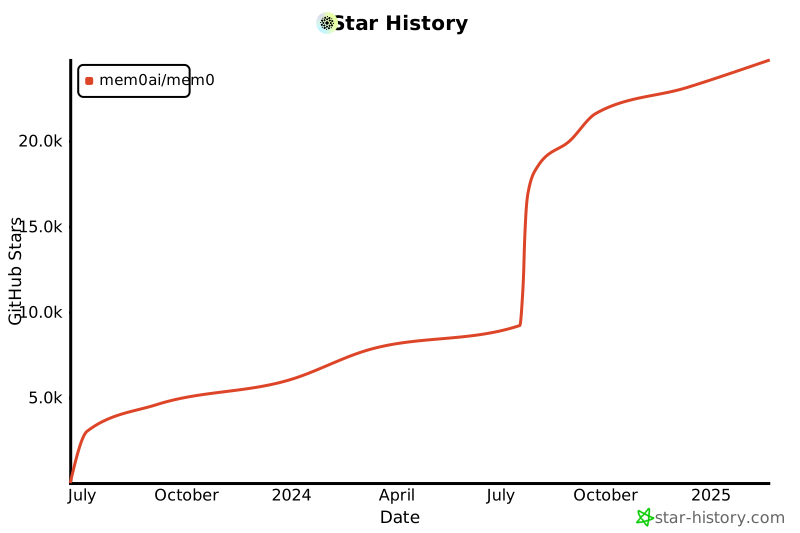](https://star-history.com/#mem0ai/mem0&Date)
## Support
Join our Slack or Discord community for support and discussions.
If you have any questions, feel free to reach out to us using one of the following methods:
- [Join our Discord](https://mem0.ai/discord)
- [Join our Slack](https://mem0.ai/slack)
- [Join our newsletter](https://mem0.ai/email)
- [Follow us on Twitter](https://x.com/mem0ai)
- [Email us](mailto:founders@mem0.ai)
## Contributors
Join our [Discord community](https://mem0.ai/discord) to learn about memory management for AI agents and LLMs, and connect with Mem0 users and contributors.
Share your ideas, questions, or feedback in our [GitHub Issues](https://github.com/mem0ai/mem0/issues).
We value and appreciate the contributions of our community. Special thanks to our contributors for helping us improve Mem0.
 ## License
This project is licensed under the Apache 2.0 License - see the [LICENSE](LICENSE) file for details.
## License
This project is licensed under the Apache 2.0 License - see the [LICENSE](LICENSE) file for details.